


Published on : October 20, 2026
This research was covered by Crunchbase here.
There’s been a lot of noise about what a moat is in a post-AI world. AI killed moats. AI created new ones. AI is the moat. AI is not the moat. Most of the arguments are vibes.
Here’s the product signal.
When AI makes building nearly free, the only moats that survive are the ones a model cannot generate. We wanted to know exactly which ones, so we took Pitchbook data on 576 VC-backed AI B2B companies that raised $50M+ rounds since the start of 2025 through Hamilton Helmer’s 7 Powers framework and layered in insights from Products That Count’s 600K+ product leader community.
This is the same approach we use in diligence at Mighty Capital. It works.
The analysis covers 5 of Hamilton Helmer’s 7 Powers (Branding and Process Power, are difficult to assess from the outside, so they’re excluded.)
And the market context makes the stakes clear: 97% of the 12,000 products nominated for the Products That Count Product Awards have AI deeply integrated. AI stopped being a differentiator a long time ago. Defensibility has to come from something more durable.
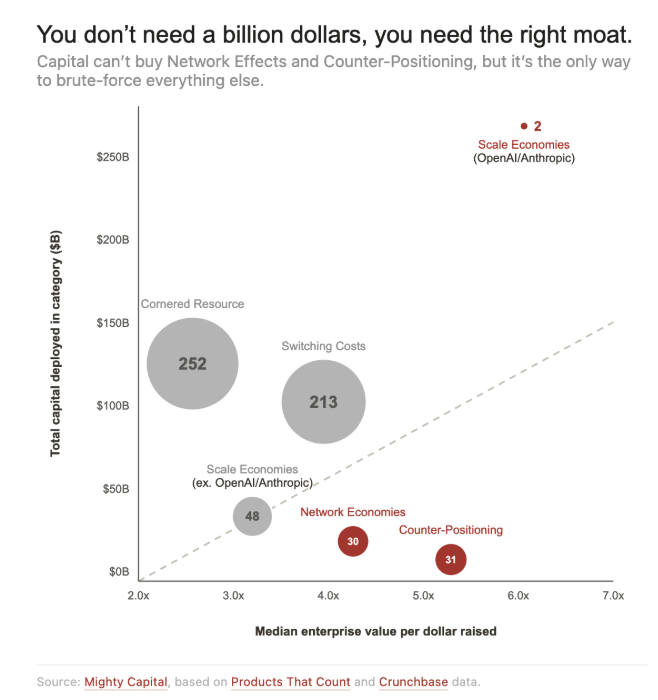
The graph below distills the key insight for founders. There are 2 paths to winning:
A newcomer adopts a new, superior business model which the incumbent can’t copy without damaging their own business. Copying would cannibalize the incumbent’s existing profits or disrupt their model in ways management is rationally unwilling to accept. Netflix vs. Blockbuster is the canonical example: Blockbuster could have copied Netflix’s model, but it would have destroyed their late-fee revenue and store economics in the process.
In our portfolio, Palantir spin-off Angle Health is the strongest case. They’re a vertically integrated AI-driven insurer selling directly to employers. Traditional brokers and legacy insurers can’t easily replicate this without cannibalizing their broker relationships, their underwriting margins, and their legacy claims infrastructure.
Abrial, another portfolio company, makes the same argument for airline revenue management. Legacy vendors like Amadeus sell expensive, slow-updating systems that generate high-margin consulting and implementation revenue. Abrial’s continuously-optimizing reinforcement learning model would gut that revenue stream if incumbents tried to match it, so they won’t until it’s too late.
In our analysis, only 5% of companies leverage Counter-Positioning but investors value them at a 5.3x multiple, making it one of the most desirable places to be building in the AI era. Here are best practices from our community of 600,000+ product practitioners to help you nail this moat:
The value of a product or service increases for every customer as more users join the network. Once a leader reaches critical mass, the game is largely over: industries with strong network economies tend toward winner-take-all outcomes, with the boundaries of the network (geography, professional vs. personal, industry vertical) as the primary constraint on how far that dominance extends. LinkedIn is the canonical example: as the user base grows, recruiters find more candidates, professionals find more connections, and job seekers find more opportunities.
In our portfolio, Canela is a clear case. This is the classic media two-sided market: audience attention on one side, advertisers on the other. The Latino-specific focus is actually a strategic strength because it creates a highly defensible domain where general-purpose streamers can’t replicate the cultural specificity, and where Canela’s first-party audience data compounds with every new viewer.
Calico, another portfolio company, is building network economies into apparel supply chains. Their multi-agent platform connects brands to a vetted network of 150+ factories and every new brand that joins makes the factory network more competitive, while every new factory makes the platform more valuable to brands. The two-sided dynamic is further reinforced by the data Calico accumulates across costing, negotiation, and production cycles.
In our analysis, only 5% of companies have Network Economies but investors value them at a 4.2x multiple, making this the most capital-efficient path to a strong valuation premium. Here are best practices from our product community:
A company gains preferential access to a scarce, valuable resource such as proprietary data, unique IP, a patent portfolio, an elite team, or exclusive rights, that competitors cannot acquire on comparable terms. The key distinction Helmer draws is that the resource must have been secured before its full value was recognized. If you pay fair market value for something everyone already knows is valuable, you’ve just bought an asset. Pixar in its early years is Helmer’s canonical example: the combination of technical innovation (RenderMan) and a uniquely talented creative team assembled before either had proven its market value. The resource was the people and the culture as much as the technology.
In our portfolio, Groq is the clearest case. Their LPU, a proprietary chip architecture for AI inference, delivered 10x the speed of GPUs. The resource wasn’t just the chip; it was the team that built it. Jonathan Ross and the engineers he assembled represent the kind of accumulated expertise that can’t be poached or replicated on a hiring plan.
The low valuation multiple (2.6x despite 44% prevalence) tells you that investors are discounting Cornered Resources as a moat in the AI era because they’ve seen too many proprietary datasets eroded by foundation models and synthetic data. If you have something unique, don’t abandon the resource but use it to get to a Power with a higher valuation multiple:
Recommended resource: 5 Types of Product Pivots and When to Make Them. The piece dissects how and when to change direction, including the Jobs to Be Done lens and the Apple/Jobs example of stripping back to a focused core and building an interconnected ecosystem around it.
Switching costs arise when a customer values compatibility, continuity, and integration across purchases from a specific vendor over time, making the cost of moving to a competitor (in time, money, retraining, data migration, and disruption risk) exceed the value of any alternative on offer. Salesforce is the classic enterprise example. Its customer’s sales operations, forecasting, and customer data are embedded in the platform, with integrations to marketing, finance, and customer success stacked on top. Salesforce can charge premium prices not only because it’s good, but because leaving hurts.
In our portfolio, Amplitude is a strong case. Once an organization’s product analytics are running on Amplitude, migrating is like a data archaeology project. The instrumentation logic is baked into the product code, the metric definitions live in the institutional memory of every PM and analyst who built them, and the historical data that makes the platform valuable doesn’t travel cleanly to a new tool.
SignalWire, another portfolio company, runs a programmable communications network where the fixed costs spread across every developer and enterprise customer added. Once a company’s voice, video, and messaging infrastructure is built on SignalWire’s Call Fabric, the switching cost becomes a re-architecture project that touches every customer-facing communication flow the business runs.
Switching Costs is the most crowded power (37% of companies) and commands a similar multiple as Network Economies (4x) while requiring roughly 10x the capital. It’s an expensive moat because its go-to-market is so costly. The implication for founders is that if you started building around a Switching Costs moat, you need to escape it using one of 2 ways:
Recommended resources:
A business in which per-unit costs decline as production volume increases has structural benefits whereby fixed costs like R&D, infrastructure, content, tooling, get spread across more and more customers, giving the scaled player a durable cost advantage that smaller rivals cannot match. Netflix and original content is Helmer’s canonical example: by shifting from licensed content (pay per view) to original content (fixed upfront cost), Netflix converted its biggest expense into a scale economy.
In our portfolio, DigitalOcean is the clearest case. Cloud infrastructure is fundamentally a fixed-cost business and every additional developer or SMB customer spreads those costs further. DigitalOcean’s strategic choice to own the developer and startup segment (where AWS and GCP generate complexity-induced friction) means it captures scale advantages in a focused niche rather than competing head-on with hyperscalers it can never out-capitalize.
Only 9% of companies in our dataset have Scale Economies, and the numbers tell you exactly why: include OpenAI and Anthropic and you see $268B raised at a 6.1x multiple, the highest of any power. Remove them and 88% of the capital vanishes, pulling the multiple down to 3.2x. Those 2 companies are essentially the entire category.
The honest advice for founders is to avoid getting trapped in the middle: believing you’re building a scale moat because your unit economics improve with growth, without recognizing that the moat only becomes real at a capital intensity most startups will never reach.
Recommended resources:
Every founder in this dataset has AI in their product. The ones commanding premium multiples are building something underneath the AI that a model can’t generate on its own.
The five powers in this analysis aren’t created equal. Two of them: Counter-Positioning and Network Economies, deliver strong multiples without requiring you to raise at OpenAI scale. Two of them: Cornered Resource and Switching Costs, are seductive but not necessarily defensible. And one of them is simply not the game most founders play.
The key takeaway for founders is that the path to a durable moat runs through business model design and network architecture. You need a structural answer for this question: what about my business would survive a well-funded competitor with a better model? That’s the only thing that matters.
If you’re ready to build, Products That Count has the resources to help you get there: best practices from 600K+ product leaders, free. productsthatcount.org.
Happy building.